 Pipsqueak
Briefing for speech-language pathologists
Pipsqueak: home speech practice, structured and scored
An iPhone and iPad app that runs short, daily speech-sound practice at home on the targets you set. A parent scores every try, and you get an honest record of what happened.
- Status
- Private testing (TestFlight). Not on the App Store yet.
- For
- Children about 5 and up, and the grown-up who practices with them.
- Platform
- iPhone and iPad. Free.
- Data
- Stays on the device. No accounts.
1What it is
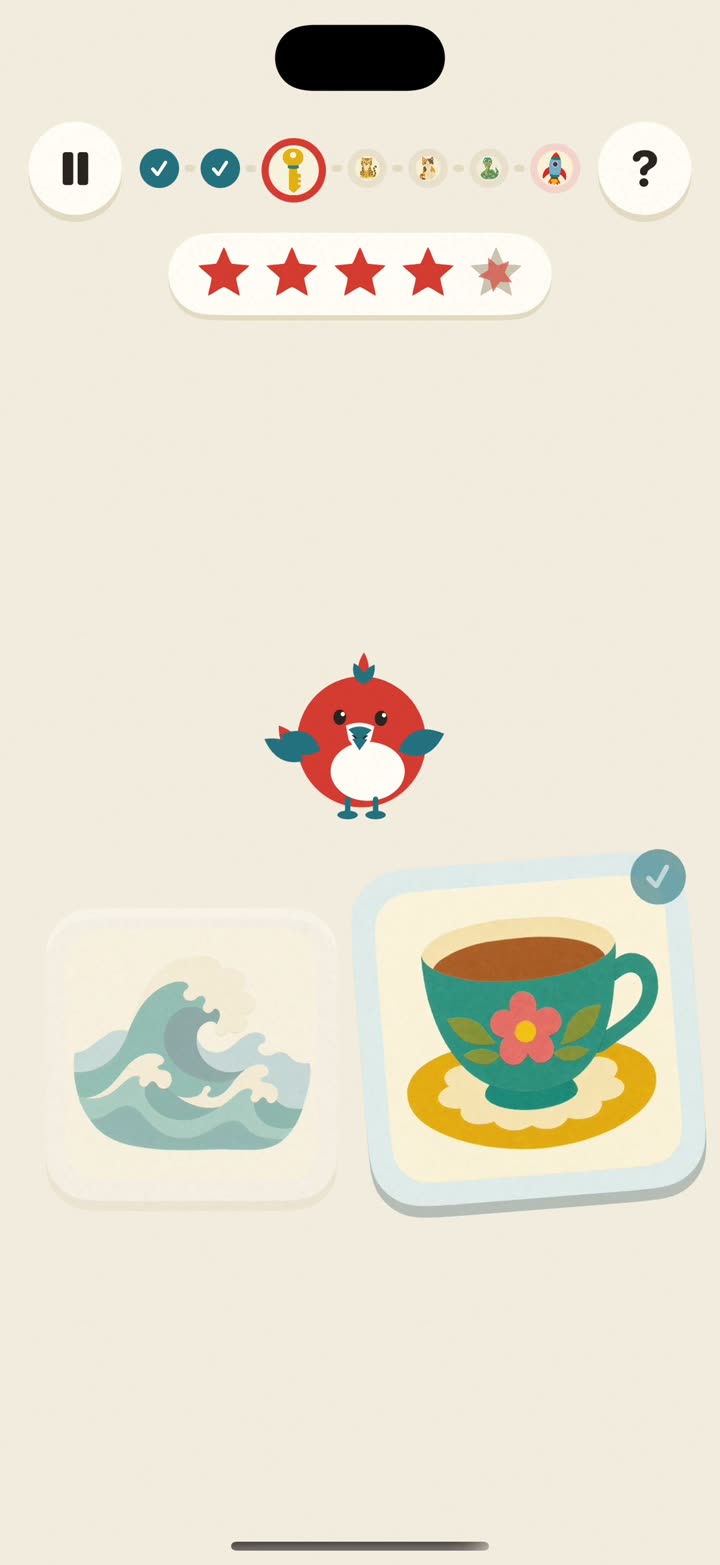
Pipsqueak is a practice companion for children with speech sound errors. Pip, a cut-paper bird, runs an 8-minute session: a short listening warm-up, then speech practice in stops of up to 12 tries, with a listening or word game between every two stops. A parent sits alongside and scores each try. The app keeps the record and suggests when to move up, step back or ask an SLP.
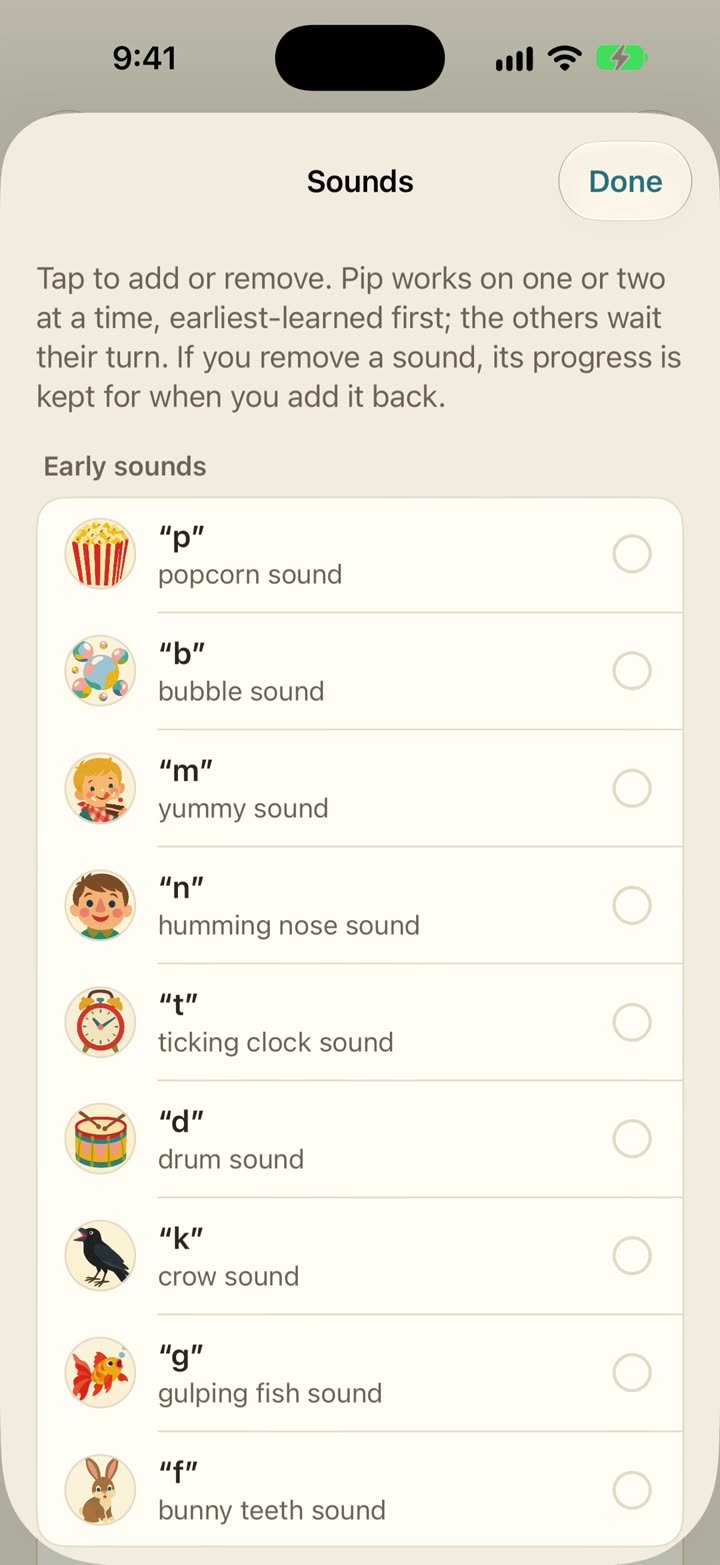
It covers 21 targets, from p and b to r, th and s-, l- and r-blends, each on the traditional hierarchy: sound alone, syllables, words (initial, final, medial), phrases, sentences and talking. See every sound’s word lists and cues.
2Why it exists
Most of the practice a child needs has to happen between sessions. Frequency matters (Allen, 2013), and studies give roughly 70–100 trials per session (Williams, 2012; Sugden et al., 2018). At home, that practice is usually unstructured: families aren’t sure they’re doing it right, and you rarely see what happened. Apps that score with speech recognition accept many errors as correct (McKechnie et al., 2018).
Pipsqueak’s job is to make home practice look like the practice you would prescribe: the right targets, enough trials, a sensible schedule, scored by a person, and reported back honestly.
3Who it’s for
- Children about 5 and up with articulation or phonological errors, including children with learning disabilities. Everything is spoken and tapped; no reading is needed.
- Families with a grown-up who can sit alongside for about 8 minutes, most days.
- SLPs who want home practice to follow their plan between sessions.
Also included: listening and phonological awareness games, early language games, and unscored talk play for children who stutter.
Not for assessment or diagnosis, or for children who need an approach an SLP must select and run, such as treatment for childhood apraxia of speech. Set-up asks red-flag questions and points those families to an SLP or audiologist.
4How it works
Set-up
The parent adds the child and picks sounds, or runs a quick picture-naming check. A few questions screen for red flags. The parent can move each sound to the step that matches your plan.
Each try
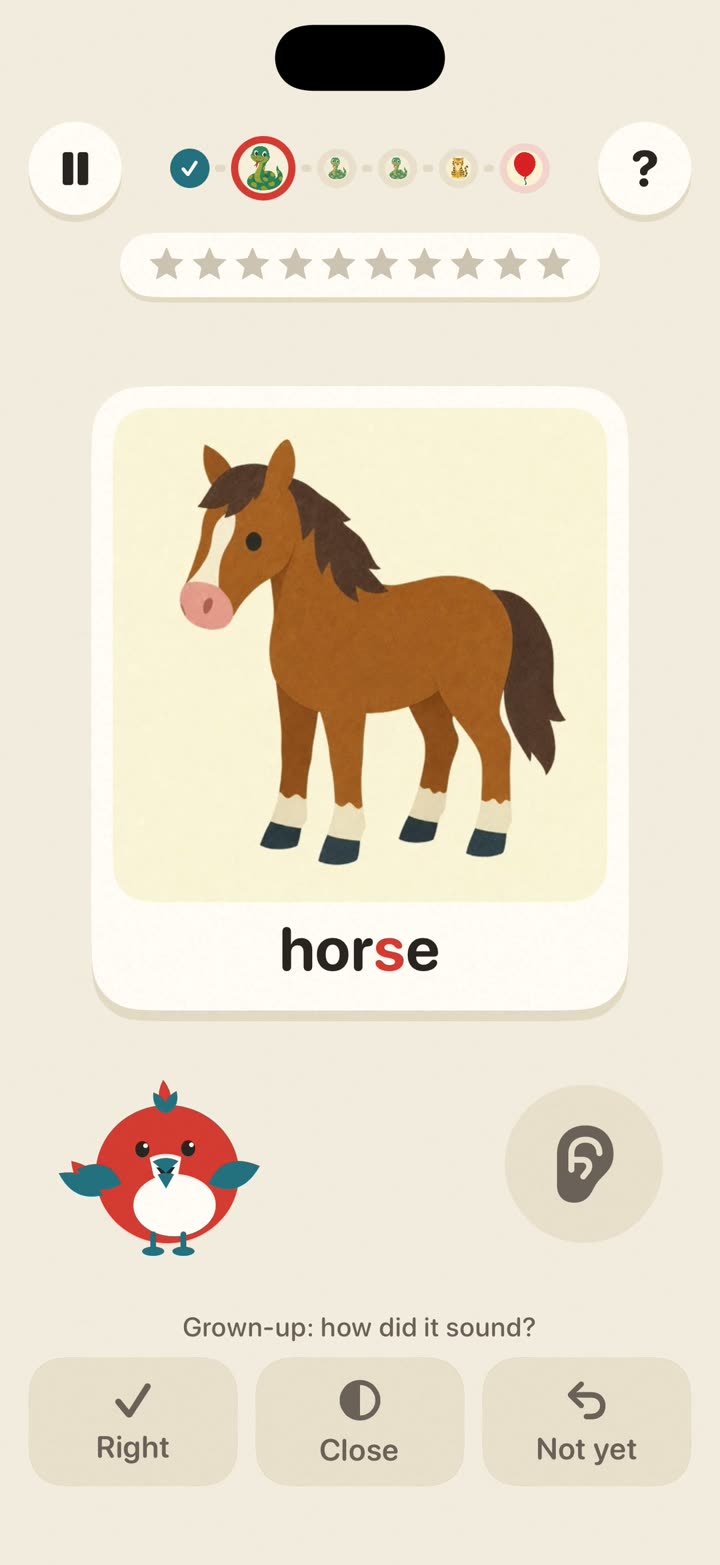
Pip models the target, the child says it, and the parent taps Right, Close or Not yet. A first Not yet at word level or below brings a placement cue and one more try. Only Right counts as correct.
The schedule
Blocked practice while a step is new, mixed once accuracy reaches 80%, and Pip’s model fades as accuracy rises. Every try earns a star; there are no timers, buzzers or streaks.
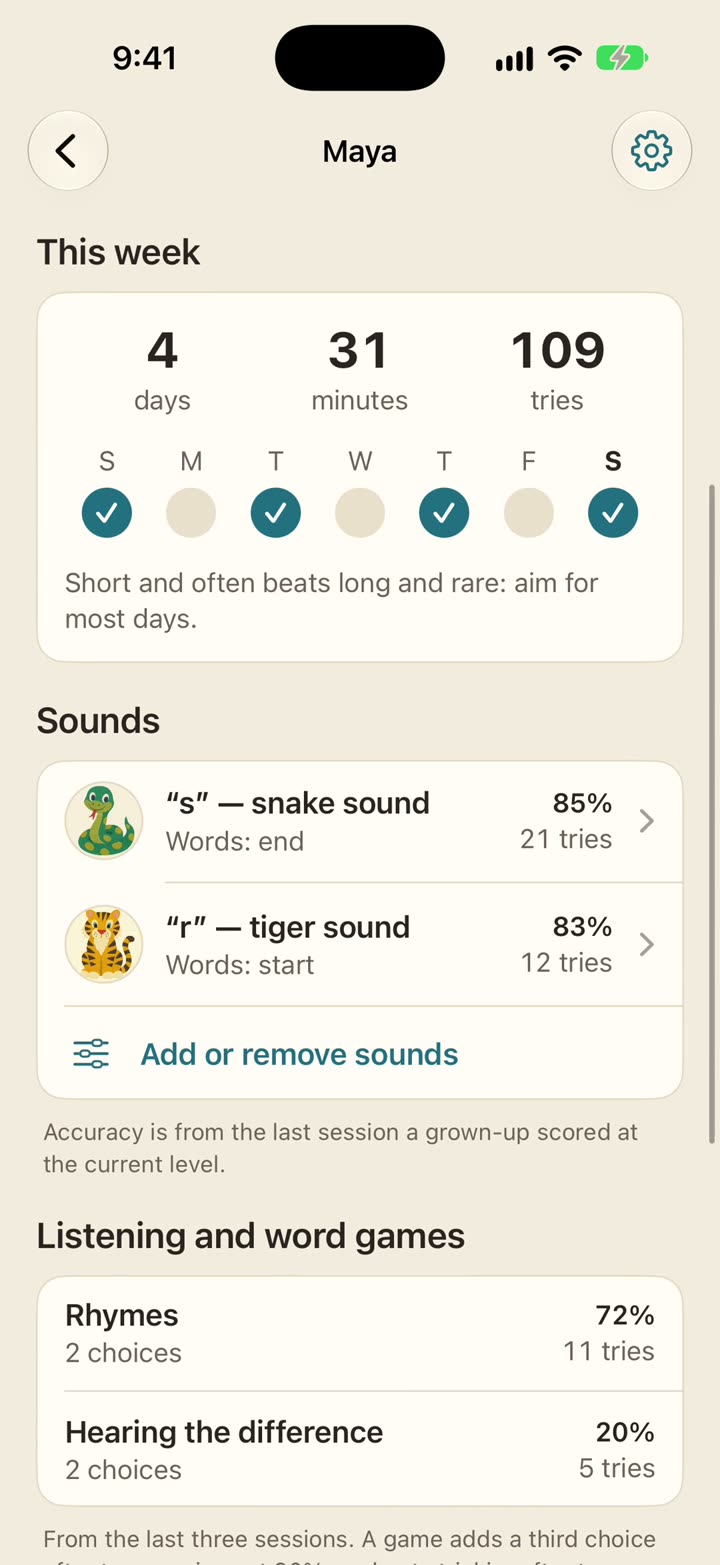
Progress
Accuracy by sound and step, always with the number of tries; new-word checks on untrained words, shown separately. Two scored sessions at 80% or better suggest moving up; about 12 sessions without progress suggest asking an SLP.
5Using it with a family
- Tell them the sounds to practice and the step for each.
- Ask them to choose “I’ll sit with them and score”, and to run the 10-item listening check once.
- Share the rule the app teaches: if in doubt, it’s Not yet.
- Ask for the progress report before your next session. For each sound it lists the step, the last scored sessions as accuracy (tries), new-word checks and listening results.
6The evidence
Each rule follows a published principle. None of these studies evaluated Pipsqueak itself.
| Principle | In Pipsqueak |
|---|---|
| Perception training alongside production (Rvachew, 1994; Rvachew et al., 2004) | A listening warm-up and right-or-silly judgments before and between practice. |
| Principles of motor learning (Maas et al., 2008) | Blocked, then random practice; feedback fades from cues to a plain “yes”. |
| Challenge point (Hitchcock & McAllister Byun, 2015) | The model fades at ≥80% over 10 tries and returns at ≤50%. |
| Dose and frequency (Allen, 2013; Sugden et al., 2018) | 20–40 tries in 8 minutes, most days. |
| Human judgment over speech recognition (McKechnie et al., 2018) | Only the parent’s scores count; recognition only cheers. |
| Untrained probes (Elbert et al., 1991) | New-word checks kept apart from practice accuracy. |
| Intelligibility benchmarks (Hustad et al., 2021) | An intelligibility question and red-flag checklist at set-up. |
7Limits
- No outcome data yet. The app applies published principles but hasn’t been studied as a whole.
- Parent scoring is only as good as the parent’s ear (Hair et al., 2021). The listening check and “if in doubt, it’s Not yet” help; a quick demonstration in session helps more.
- No assessment. No age-equivalents, percentiles or diagnostic labels.
- Privacy. No accounts, analytics or ads. Recordings and scores stay on the device, and the progress report goes only where the parent sends it. From version 1.1, the app downloads a list of Las Vegas speech therapists for parents; searching it happens on the device.